
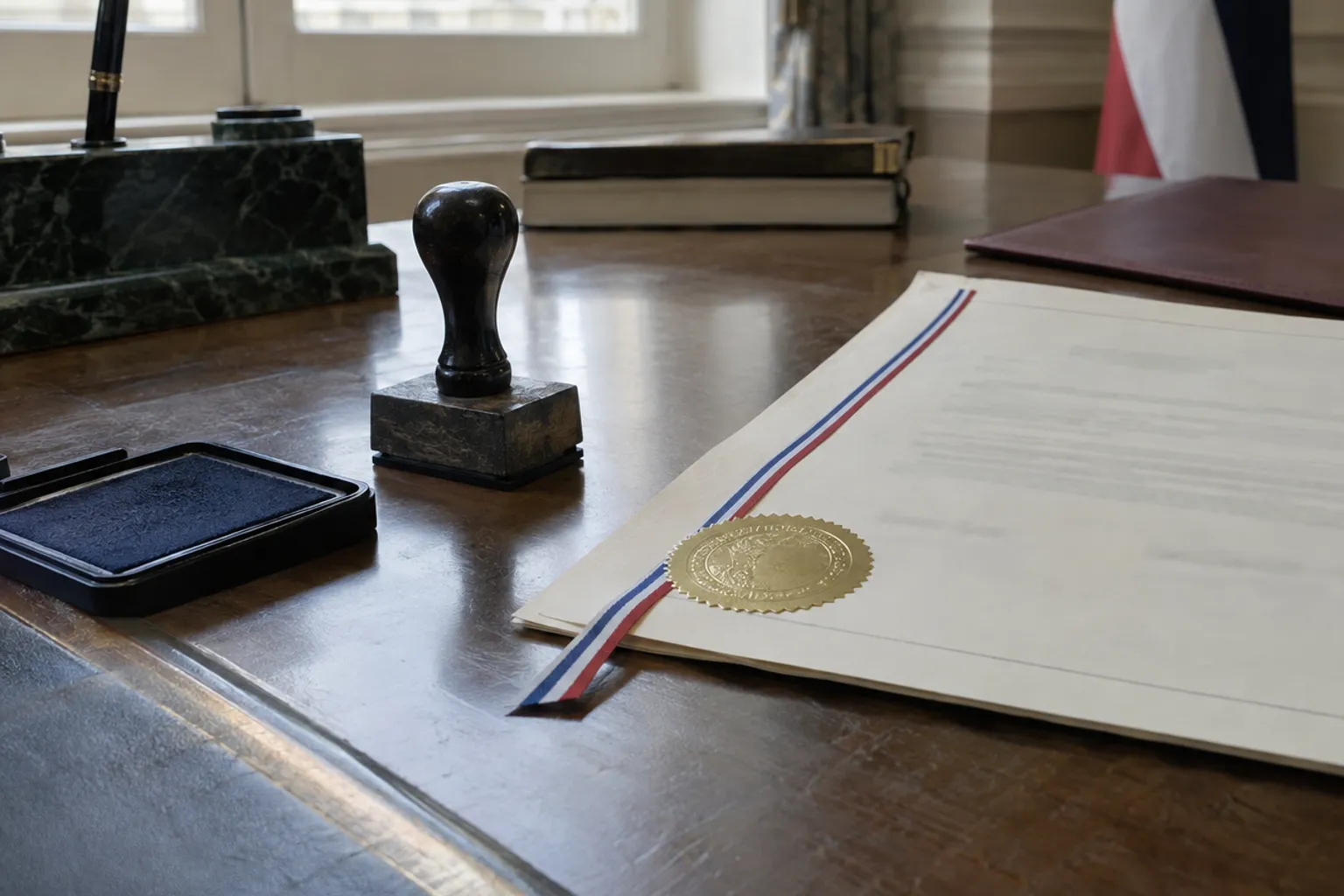
Heirs abroad usually sign a notarial power of attorney either at a Greek consular authority, which can draw up notarial deeds including powers of attorney, or before a local notary, with an apostille under the 1961 Hague Convention, to which Greece is a party, or with consular legalisation where the country is not party to that Convention. A renunciation through a representative requires a special power of attorney in notarial form. Some acts cannot be delegated: a will, an inheritance contract and an advance waiver of inheritance rights must be made in person.
Two routes
- Greek consular authority: consular authorities draw up notarial deeds, including powers of attorney for sales, acceptance of an inheritance or court representation. The person granting it appears in person with an identity card or passport, and the full identity details of the attorney are included in the text. Check the specific consulate's appointment rules and fees.
- Local notary plus apostille: a power of attorney signed before a notary in a country that is a party to the 1961 Hague Apostille Convention is authenticated with an apostille in that country. Greece has been a party since 1985. In a country that is not a party, the document needs legalisation through the Greek consular authority instead of an apostille, or the power of attorney can be signed at the Greek consular authority itself. Ask the Greek notary or lawyer who will use the document, in advance, whether and in what form a translation is needed.
What the power of attorney should cover
A single, carefully drafted power of attorney saves repeated trips to the consulate. For an inheritance it typically covers:
- applying for the tax number and dealing with the tax authority, including the inheritance tax return;
- obtaining certificates, the death certificate, and the publication of a will;
- signing the notarial acceptance of the inheritance and applying for its registration; the Cadastre accepts applications from a lawyer or from an attorney holding a notarial power of attorney;
- dealing with banks and, where intended, selling, dividing or renting the property;
- if relevant, renouncing the inheritance, which needs a special power of attorney in notarial form.
Acts that must be done in person
A will is made only by the testator personally. From 16 September 2026, an inheritance contract and a contract waiving future inheritance rights are made before a notary with the parties appearing in person. These cannot be signed through an attorney.
Questions clients ask
Is an apostille needed for a power of attorney made in another EU country?
Usually yes. The EU Succession Regulation removes legalisation only for documents issued under that Regulation, such as the European Certificate of Succession, not for ordinary powers of attorney.
Can one heir act for all the others?
Yes, if each of the others gives him a power of attorney covering the acts needed; each heir's own decisions, such as renunciation, still need his specific authority.
Sources
- Υπουργείο Εξωτερικών, Πρεσβεία στη Νορβηγία: Πληρεξούσια (προξενικές συμβολαιογραφικές πράξεις)
- HCCH, Apostille Convention (1961) status table: Greece
- ΑΚ 1846 (Αστικός Κώδικας, π.δ. 456/1984, όπως ισχύει μετά τον ν. 5303/2026)
- ΑΚ 1716 (Αστικός Κώδικας, π.δ. 456/1984, όπως ισχύει μετά τον ν. 5303/2026)
- ΑΚ 1798 (Αστικός Κώδικας, π.δ. 456/1984, όπως ισχύει μετά τον ν. 5303/2026)
- ΑΚ 1839 (Αστικός Κώδικας, π.δ. 456/1984, όπως ισχύει μετά τον ν. 5303/2026)
- ν. 2664/1998 (Εθνικό Κτηματολόγιο), άρθρο 14
- Κανονισμός (ΕΕ) 650/2012, άρθρ. 74
- mitos.gov.gr: Επικύρωση εγγράφων αλλοδαπών αρχών χωρών εκτός Σύμβασης της Χάγης
This page is general information, not legal advice; the answer in any real case depends on its facts and dates.
L+A advises families, business owners and heirs living abroad on inheritance and succession in Greece.